
Chlorine and chloramines
added by water authorities to disinfect the supply. They cause the "pool" taste and smell and can dry out skin and hair.
Home / Water Filtration System
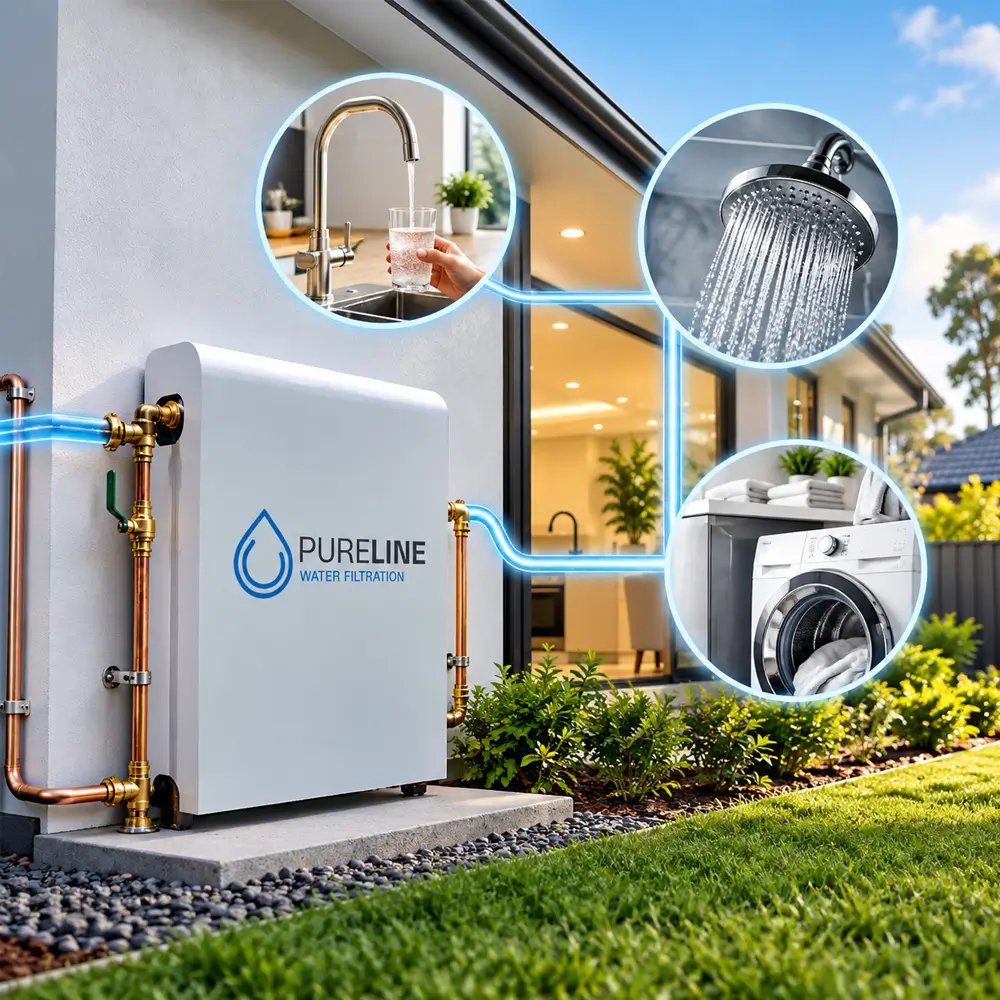
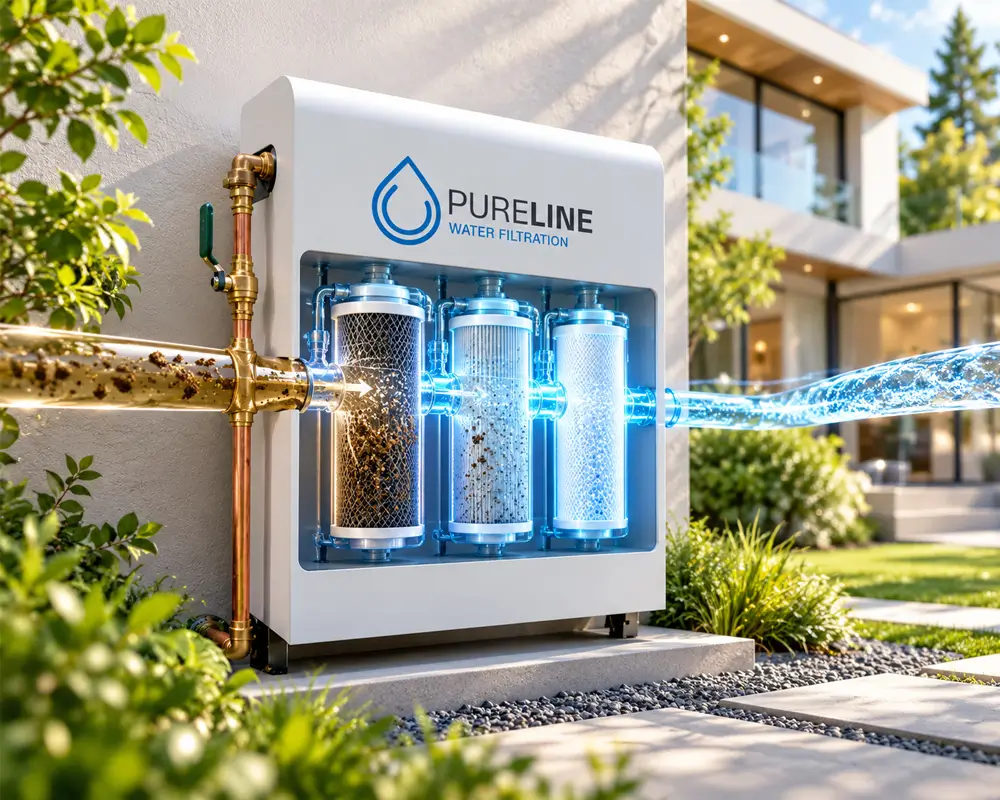
The PureLine triple-stage system is a whole house water filter that fits on your cold water main before the water reaches any tap. It uses three 20" x 4.5" Big Blue cartridges to remove sediment, reduce chlorine by more than 95% and cut VOCs and pesticides by more than 90%. It handles around 30 litres per minute and is WaterMark certified.
| Specification | Value |
|---|---|
| Filter stages | 3 x 20" x 4.5" Big Blue cartridges |
| Flow rate | Approx. 30 L/min |
| Operating pressure | 0.2 to 0.8 MPa |
| Operating temperature | 5 to 38°C |
| Chlorine reduction | More than 95% |
| VOC and pesticide reduction | More than 90% |
| Maximum turbidity | 5 NTU |
| Cartridge life | 6 to 12 months (depends on water quality and usage) |
| Dimensions (installed unit) | 575 x 213 x 760 mm |
| Packed size / gross weight | 650 x 290 x 840 mm / 34 kg |
| Certification | WaterMark certified; AS/NZS 4020:2018 compliant |
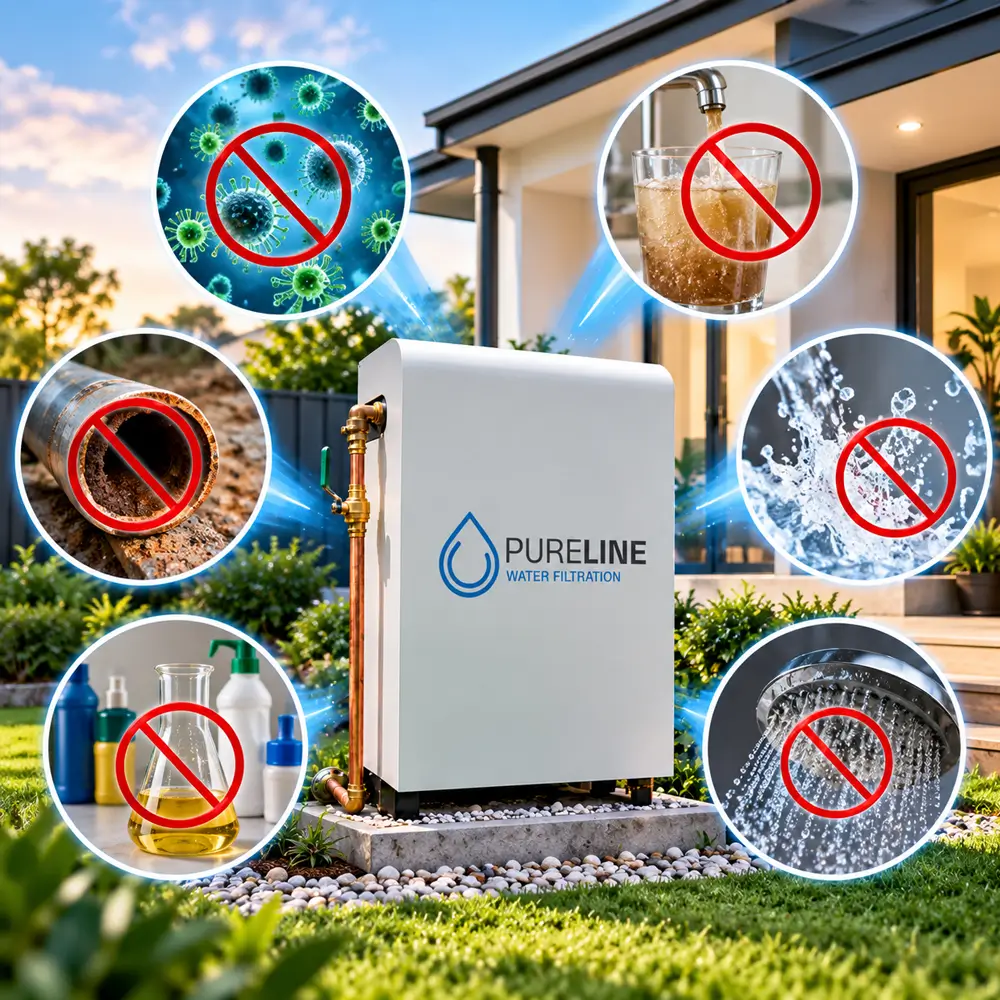
Australian mains water is treated to meet the Australian Drinking Water Guidelines, so it's safe to drink. But treatment and old pipes still leave things behind that affect taste, skin and appliances.
added by water authorities to disinfect the supply. They cause the "pool" taste and smell and can dry out skin and hair.
picked up from ageing mains and household pipes. They cloud water and wear out tapware and appliances.
such as lead and copper, which can leach from old plumbing fittings.
traces of pesticides, herbicides and volatile organic compounds (VOCs).
calcium and magnesium that leave limescale. Melbourne water is soft, while supplies in places like Adelaide and Perth are much harder.
| Stage | Cartridge | What it does | Why it matters |
|---|---|---|---|
| 01 | 10 μm antibacterial pleated PP sediment filter | Traps sand, silt, rust and micro-particles. Antibacterial media reduces microbial growth on the filter itself. | Protects stages 2 and 3, extends their life and keeps grit out of your plumbing. |
| 02 | 1 μm scale-reducing carbon (CTO) filter | Reduces chlorine, chloramines, VOCs, pesticides, herbicides, iron, hydrogen sulfide and some heavy metals. Helps limit scale. | Protects tapware, showers, baths and appliances from staining, scale and odour. |
| 03 | 1 μm coconut shell carbon (CTO) filter | Polishes taste and odour and removes remaining chemicals and fine particles. | Cleaner-tasting water for drinking, cooking and making tea and coffee. |
Being clear about the limits helps you choose the right setup.
It isn't a disinfection unit. It's designed for treated mains water, not untreated tank, bore or creek water. Those need testing and extra treatment such as UV.
It doesn't remove fluoride. The carbon stages aren't designed for it.
It isn't a salt-based softener. Stage 2 helps limit scale, but very hard water may still need a dedicated softener.
The standard cartridges aren't PFAS-rated.
A single cartridge trying to catch everything clogs quickly, because sand and rust block the fine carbon before it can do its job. Splitting the work into three stages fixes that. The coarse sediment filter takes the grit, which leaves the two 1 micron carbon stages free to deal with chlorine, chemicals and taste.
The result is steadier flow, longer cartridge life and better filtration than one cartridge doing it all. It's also why the larger 20" x 4.5" Big Blue size matters. More filter media means more water filtered before a change is due.
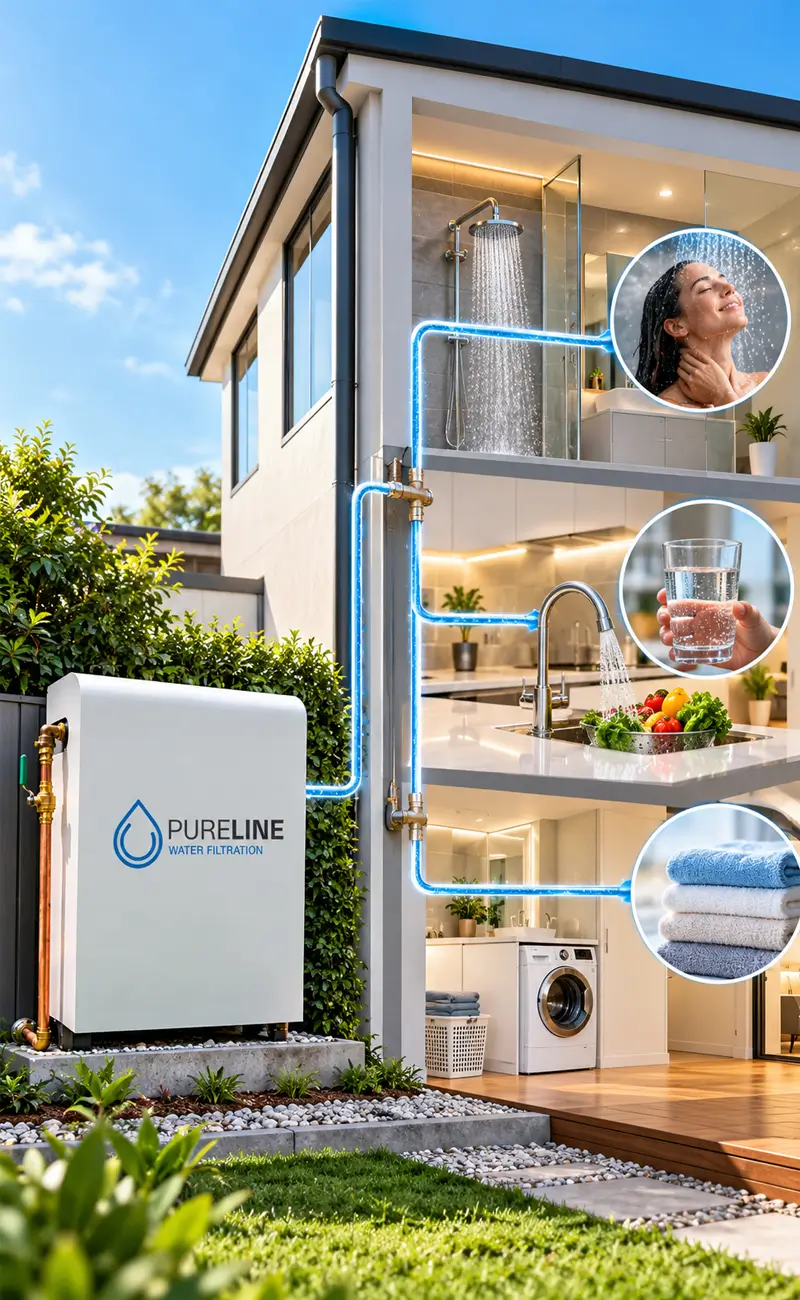
The system suits houses of any size, new builds and renovations. It also fits small commercial sites like offices, cafes and restaurants that want filtered water across the premises. Your plumber installs it on the main supply line, so it covers the kitchen, bathrooms, laundry and garden taps in one go.
Book a Free In-Home AssessmentThe system needs wall space of roughly 575 mm wide by 760 mm high, usually on an external wall near the water meter.
Plan on replacing cartridges every 6 to 12 months. Homes with more sediment or bigger households sit at the shorter end. Each change uses the spanner supplied with the system and takes about 5 to 10 minutes per cartridge. When you change them, check the O-rings and seals and replace any that look worn.
We'll remind you when a change is due.
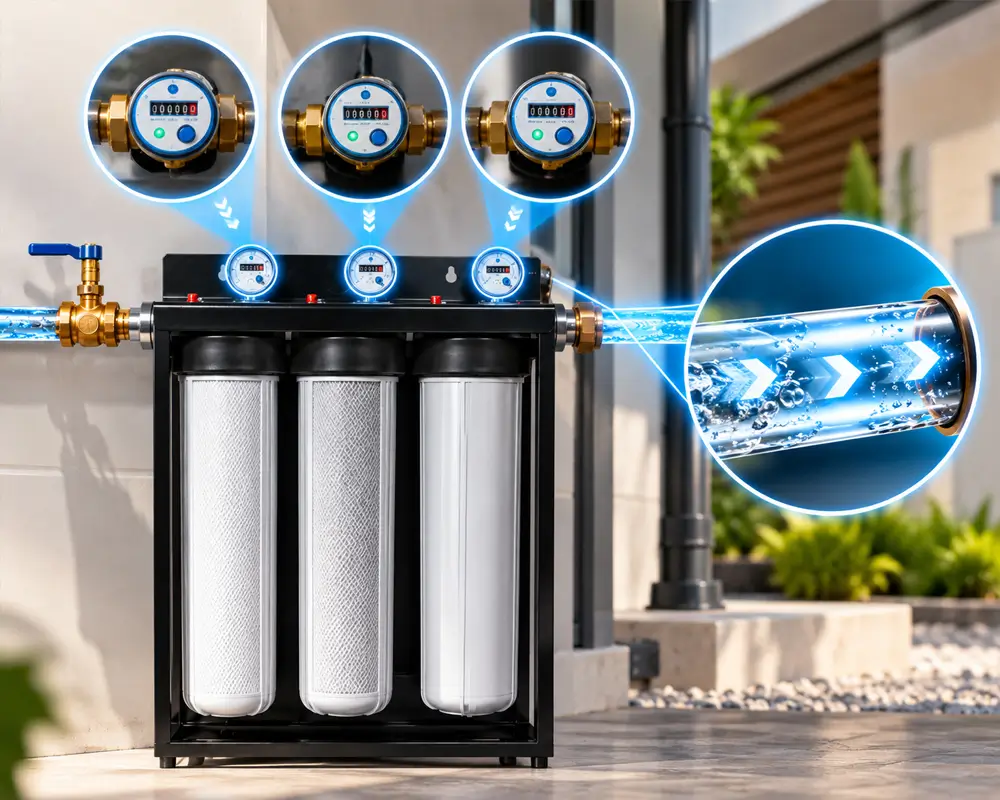
The system is WaterMark certified, which means it meets Australian requirements for plumbing products. It has also been tested to AS/NZS 4020:2018 and passed every category: taste, appearance, microbial growth, cytotoxicity, mutagenicity, metals and organic compounds. Housings are food-grade, with stainless steel mounting brackets.
Learn about our standards →For installer training and support, become a PureLine dealer.
"Big Blue" is the common name for a 20" x 4.5" filter housing. The larger size lets more water through with less pressure drop and holds more filter media, so cartridges last longer than standard 10" filters.
It's the size of particle the cartridge is rated to trap. One micron is a thousandth of a millimetre, far smaller than anything you can see.
This system reduces chlorine by more than 95%, VOCs and pesticides by more than 90%, and also reduces chloramines, sediment, rust, iron and some heavy metals.
For most homes, yes. That flow covers a shower, a tap and a washing machine running at the same time in a typical household.
Between 6 and 12 months. The exact life depends on how much water you use and how much sediment is in your supply.
Yes. The system comes with a spanner, and each cartridge takes about 5 to 10 minutes. We can also do it for you.
It can, with a suitable pre-filter, but it isn't a disinfection system. Untreated water should be tested first and may need UV treatment as well.
Yes. It's designed for high-flow, whole-premises use, including offices and restaurants. We'll check your demand at the assessment.
Every property is different. Book a free assessment and we'll check your water, measure up and give you a fixed written quote for your whole house water filter.